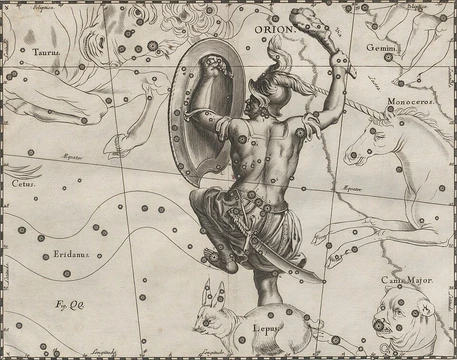
Canis Major
Constellation containing Sirius, the brightest star in the night sky.

via Wikipedia: Canis Major · see source
Canis Major is a constellation in the southern celestial hemisphere. Its name is Latin for 'greater dog' in contrast to Canis Minor, the 'lesser dog'; both figures are commonly represented as following the constellation of Orion, the hunter, through the sky. In the second century, it was included in Ptolemy's 48 constellations, and is counted among the 88 modern constellations. The Milky Way passes through Canis Major and several open clusters lie within its borders, most notably M41.
- type
- constellation
- area_sq_deg
- 380
- rank_by_size
- 43
- brightest_star
- Sirius (Alpha Canis Majoris)
- number_of_bright_stars_above_magnitude_2
- 4
- abbreviation
- CMa
Lore & Background
In ancient Mesopotamia, Sirius, named KAK.SI.SA2 by the Babylonians, was seen as an arrow aiming towards Orion, while the southern stars of Canis Major and a part of Puppis were viewed as a bow, named BAN in the Three Stars Each tablets, dating to around 1100 BC. In the later compendium MUL.APIN, the arrow, Sirius, was linked with the warrior Ninurta, and the bow with Ishtar, daughter of Enlil. The Ancient Greeks replaced the bow and arrow depiction with that of a dog. In Greek mythology, Canis Major represented the dog Laelaps, a gift from Zeus to Europa; or sometimes the hound of Procris, Diana's nymph; or the one given by Aurora to Cephalus, so famed for its speed that Zeus elevated it to the sky. It was also considered to represent one of Orion's hunting dogs, pursuing Lepus the Hare or helping Orion fight Taurus the Bull; and is referred to in this way by Aratos, Homer and Hesiod. The ancient Greeks refer only to one dog, but by Roman times, Canis Minor appears as Orion's second dog. Alternative names include Canis Sequens and Canis Alter. Canis Syrius was the name used in the 1521 Alfonsine tables. The Roman myth refers to Canis Major as Custos Europae, the dog guarding Europa but failing to prevent her abduction by Jupiter in the form of a bull, and as Janitor Lethaeus, 'the watchdog'. In medieval Arab astronomy, the constellation became al-Kalb al-Akbar, 'the Greater Dog', transcribed as Alcheleb Alachbar by 17th century writer Edmund Chilmead. Islamic scholar Abū Rayḥān al-Bīrūnī referred to Orion as Kalb al-Jabbār, 'the Dog of the Giant'. Among the Merazig of Tunisia, shepherds note six constellations that mark the passage of the dry, hot season; one of them, called Merzem, includes the stars of Canis Major and Canis Minor and is the herald of two weeks of hot weather.
Reader's Guide
Canis Major is significant as the home of Sirius, the brightest star in the night sky, known as the 'dog star'. Its brightness is due to its proximity to the Solar System and its intrinsic brightness. At magnitude 1.5, Epsilon Canis Majoris (Adhara) is the second-brightest star of the constellation and the brightest source of extreme ultraviolet radiation in the night sky. Next in brightness are the yellow-white supergiant Delta (Wezen) at 1.8, the blue-white giant Beta (Mirzam) at 2.0, blue-white supergiants Eta (Aludra) at 2.4 and Omicron2 at 3.0, and white spectroscopic binary Zeta (Furud), also at 3.0. The red hypergiant VY CMa is one of the largest stars known, while the neutron star RX J0720.4-3125 has a radius of a mere 5 km. In Chinese astronomy, the modern constellation of Canis Major is located in the Vermilion Bird, where the stars were classified in several separate asterisms. The Military Market was a circular pattern of stars containing Nu3, Beta, Xi1 and Xi2, and some stars from Lepus. The Wild Cockerel was at the centre of the Military Market. Sirius was Tiānláng, the Celestial Wolf, denoting invasion and plunder. Southeast of the Wolf was the asterism Húshǐ, the celestial Bow and Arrow, interpreted as containing Delta, Epsilon, Eta and Kappa Canis Majoris and Delta Velorum. The Māori people recognized the figure of Canis Major as a distinct entity, though it was sometimes absorbed into other constellations. Te Huinga-o-Rehua, also called Te Putahi-nui-o-Rehua and Te Kahui-Takurua, was a Māori constellation that included both Canis Minor and Canis Major, along with some surrounding stars. The Tharumba people saw three stars of Canis Major as Wunbula (Bat) and his two wives Murrumbool (Mrs Brown Snake) and Moodtha (Mrs Black Snake). To the Boorong people of Victoria, Sigma Canis Majoris was Unurgunite, and its flanking stars Delta and Epsilon were his two wives.
Did You Know?
- Sirius is the brightest star in the night sky at apparent magnitude −1.46 and one of the closest stars to Earth at a distance of 8.6 light-years.
- Epsilon Canis Majoris (Adhara) shone at magnitude −3.99 around 4.7 million years ago, making it the brightest star in the night sky at that time.
- The red hypergiant VY CMa is one of the largest stars known, while the neutron star RX J0720.4-3125 has a radius of only 5 km.
- In Chinese astronomy, Sirius was called Tiānláng, the Celestial Wolf, denoting invasion and plunder.
- The Boorong people of Victoria named Sigma Canis Majoris Unurgunite, with flanking stars Delta and Epsilon as his two wives.
Common Misconceptions (Editorial)
Some people think that Canis Minor is Orion’s only hunting dog in ancient Greek sources, but the facts show that the ancient Greeks originally referred to only one dog—Canis Major—and that Canis Minor appears as Orion’s second dog only by Roman times. Another misconception is that the constellation has always been depicted as a dog; in ancient Mesopotamia, its stars were seen as a bow and arrow, with Sirius as an arrow aimed at Orion, not as part of a canine figure.
Why It Matters (Editorial)
Canis Major endures because it contains Sirius, the brightest star in our night sky, a celestial beacon that has guided and inspired cultures from the Babylonians to the Boorong people. Its mythology—woven through Mesopotamian, Greek, Roman, Arab, and African traditions—shows how a single set of stars can hold radically different meanings across time and place, reminding us that the night sky is a shared human canvas for storytelling and wonder.
More in Constellations 1-22
Spotted an error? Know more?
This is a living reference — every entry is fact-audited, and reader corrections feed straight into our audit queue. Suggest an edit · See this site's audit record