Scorpius
Ancient zodiac constellation with bright stars and rich mythology.

Scorpius is a zodiac constellation located in the Southern celestial hemisphere, near the center of the Milky Way, between Libra to the west and Sagittarius to the east. Its recognition predates Greek culture, and it is one of the 48 constellations identified by the Greek astronomer Ptolemy in the second century.
- largest_known_star
- AH Scorpii is large (1,400 times larger than Sun), but not the largest; UY Scuti and Stephenson 2-18 are larger.
Lore & Background
Scorpius contains many bright stars, including Antares, named 'rival of Mars' for its reddish hue. The stars λ Sco and υ Sco mark the tip of the scorpion's curved tail and are sometimes called the Cat's Eyes. The star δ Sco flared in July 2000 from magnitude 2.3 to 1.6 and became variable. U Scorpii was long considered the fastest known nova, with a period of about 10 years, but other novae like V2487 Oph have shorter recurrence times. However, it is not the largest known star; that title belongs to stars like UY Scuti and Stephenson 2-18.
Reader's Guide
Scorpius is significant as one of the oldest recognized constellations, predating Greek culture and cataloged by Ptolemy. Its location along the Milky Way provides a rich field for deep-sky objects, including open clusters Messier 6 and Messier 7, and globular clusters Messier 4 and Messier 80. The constellation's mythology is tied to Orion in Greek myths, where a scorpion sent by Artemis or Apollo killed the hunter. In non-Western astronomy, Babylonians called it MUL.GIR.TAB ('the creature with a burning sting'), and in Hawaii it is known as Maui's Fishhook. The Western astrological sign Scorpio differs from the astronomical constellation, with the Sun in Scorpius for only six days. Its bright stars and variable phenomena, such as the flaring δ Sco and the nova U Scorpii, make it a subject of ongoing astronomical interest.
Did You Know?
- The star δ Sco flared from magnitude 2.3 to 1.6 in July 2000 and became variable.
- U Scorpii was long considered the fastest known nova, but other novae like V2487 Oph have shorter recurrence times.
- In Hawaii, Scorpius is known as Maui's Fishhook (Ka Makau Nui o Māui).
Stellar Highlights and Notable Stars
Scorpius is home to some of the most remarkable stars in the night sky. Antares, the constellation's brightest member, earned its name as a "rival of Mars" because of its striking reddish glow. The curved tail is tipped by Shaula and Lesath, a pair whose names both translate to "sting" and which observers have nicknamed the Cat's Eyes for their close proximity. Most of the constellation's luminous stars are massive members of the Scorpius-Centaurus OB association, the nearest such grouping to Earth. Dschubba, meaning "the forehead," underwent a dramatic flare in July 2000, jumping from a steady 2.3 magnitude to 1.9 within weeks; it has since settled into a variable pattern oscillating between 2.0 and 1.6, making it the second-brightest star in the constellation at peak. U Scorpii holds the distinction of being the fastest known nova, cycling roughly every ten years.
Deep-Sky Treasures in the Galactic Core
Because Scorpius sits near the galactic center of the Milky Way, it is densely packed with deep-sky objects. The open clusters Messier 6, popularly called the Butterfly Cluster, and Messier 7, known as the Ptolemy Cluster, are among its most celebrated targets. The constellation's position straddling the Milky Way's densest band makes it a prime target for both amateur and professional astronomers seeking to explore the structure of our galaxy.
Mythology and Cross-Cultural Interpretations
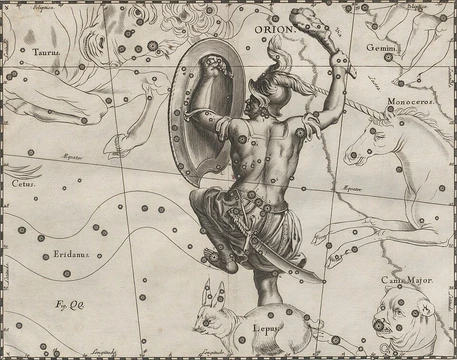
In Greek tradition, Scorpius is most famously linked to Orion. One telling has Orion boasting to Artemis and Leto that he would slay every beast on Earth; the goddesses dispatched a giant scorpion to end his life. Zeus, witnessing the struggle, placed both figures among the stars as a caution against hubris. In a variant, it was Apollo who sent the scorpion after Orion had humbly acknowledged Artemis's superiority. In both accounts, Artemis petitioned Zeus to elevate Orion, and the two constellations were set to appear in opposite seasons—Orion hunts in winter while fleeing the scorpion's summer rise. A separate Greek myth, unconnected to Orion, has the celestial scorpion confronting Phaethon as he recklessly drives his father Helios's Sun Chariot. Beyond the Mediterranean, the Babylonians read the signs as MUL.GIR.TAB, a creature with a burning sting. The Javanese see a brooded swan or a leaning coconut tree, while Hawaiian tradition identifies the shape as Maui's great fishhook, Manaiakalani. Bugis sailors split the constellation into "skate stars" and "shark stars" for navigation.
Historical Recognition and the Libra Question
Scorpius is one of the 48 constellations catalogued by the Greek astronomer Ptolemy in the second century, yet its recognition stretches well before Greek culture. In ancient Greek and Babylonian astronomy, the stars we now assign to Libra were considered the scorpion's claws—Chelae Scorpionis in Greek, zibānītu in Babylonian. The separation into a distinct constellation of Libra was formalized during the Greek or Roman period, with the westernmost stars reinterpreted as a set of scales held aloft by Astraea, the figure represented by adjacent Virgo. Even today, the star once designated γ Sco, though well within Libra's modern boundaries, is catalogued as σ Lib. In the flag of Brazil, Scorpius symbolizes the Northeast region. Astrologically, the Western sign Scorpio bears little resemblance to the astronomical constellation; the Sun actually transits Scorpius's IAU-defined boundaries for only six days, from November 23 to November 28. In Hindu astronomy, the constellation corresponds to the nakshatras Anuradha, Jyeshtha, and Mula.
Common Misconceptions (Editorial)
Some people believe Scorpius contains the largest known star, but according to the facts on record, stars like UY Scuti and Stephenson 2-18 are larger than any star in Scorpius, including AH Scorpii. Another misconception is that U Scorpii is the fastest known nova; in reality, other novae like V2487 Oph have shorter recurrence times.
Why It Matters (Editorial)
Scorpius endures as a cultural and astronomical landmark because its bright stars and distinctive shape have been recognized across civilizations, from ancient Greece to Hawaii, where it is known as Maui’s Fishhook. Its location near the center of the Milky Way also makes it a rich field for studying stellar phenomena, including variable stars and novae, connecting ancient myth to modern science.
Frequently Asked Questions
What is Scorpius and where can I find it in the sky?
Scorpius is a zodiac constellation sitting in the Southern celestial hemisphere, nestled between Libra to the west and Sagittarius to the east. It lies near the heart of the Milky Way, which makes it one of the most visually striking regions of the night sky.
What is the mythology behind Scorpius?
In Greek myth, a scorpion was dispatched by Gaia (or Artemis, in some tellings) to take down the boastful hunter Orion, who claimed he could slay every beast on Earth. The two are placed on opposite sides of the celestial sphere so they never rise together.
What is the brightest star in Scorpius?
Antares, a red supergiant near the constellation's center, is its most luminous star and gives the region its characteristic deep-red glow. Its name derives from the Greek 'anti-Ares,' meaning 'rival of Mars,' a nod to the similar hue it shares with the planet.
Why is Scorpius historically significant?
The constellation was recognized long before Greek astronomy took shape and was catalogued by Ptolemy in the second century as one of his 48 official constellations. Because it sits along the ecliptic, it served as a key marker for tracking the Sun's annual path, cementing its place in the zodiac.
Does Scorpius contain any record-breaking stars?
AH Scorpii is a massive star roughly 1,400 times the Sun's diameter, though it does not hold the overall size record—those belong to UY Scuti and Stephenson 2-18. Even so, it makes Scorpius one of the richest constellations for observing extreme stellar objects.
More in Constellations 1-22
Spotted an error? Know more?
This is a living reference — every entry is fact-audited, and reader corrections feed straight into our audit queue. Suggest an edit · See this site's audit record