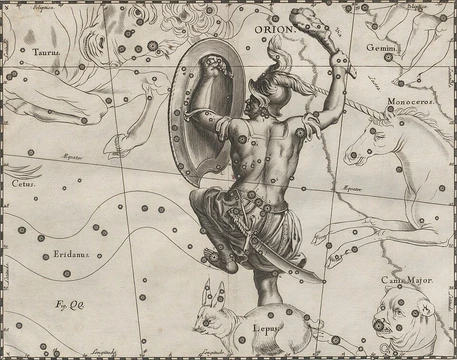
Gemini
A zodiac constellation representing the twins Castor and Pollux.

Gemini is one of the constellations of the zodiac, located in the northern celestial hemisphere. It was one of the 48 constellations described by the 2nd century AD astronomer Ptolemy and remains one of the 88 modern constellations. Its name is Latin for twins, and it is associated with the twins Castor and Pollux in Greek mythology.
- Constellation family
- Zodiac
- Brightest star
- Pollux (β Gem)
- Second brightest star
- Castor (α Gem)
- Number of naked-eye stars
- 85
- Major meteor shower
- Geminids (peak December 13–14)
Lore & Background
In Babylonian astronomy, the stars Castor and Pollux were known as the Great Twins, regarded as minor gods called Meshlamtaea and Lugalirra, titles of Nergal, the god of plague and pestilence. In Greek mythology, Gemini is associated with Castor and Pollux, children of Leda. Pollux was the son of Zeus, while Castor was the son of Tyndareus, king of Sparta. When Castor died, Pollux begged Zeus to give Castor immortality, and Zeus united them in the heavens. The twins were also protectors of sailors, associated with St. Elmo's fire.
Reader's Guide
Gemini lies between Taurus to the west and Cancer to the east, with Auriga and Lynx to the north, Monoceros and Canis Minor to the south, and Orion to the south-west. It is prominent in the winter skies of the Northern Hemisphere and visible all night in December–January. The easiest way to locate it is to find its two brightest stars, Castor and Pollux, eastward from the V-shaped Hyades of Taurus and Orion's Belt. The constellation contains 85 naked-eye stars, with Pollux as the brightest, an orange giant with an extrasolar planet. Castor is a sextuple star system. The Geminids meteor shower peaks December 13–14 with up to 100 meteors per hour. The constellation's visualization shows two parallel lines descending from Castor and Pollux, forming two figures; H. A. Rey suggested an alternative showing twins holding hands.
Did You Know?
- Gemini was one of the 48 constellations described by the 2nd century AD astronomer Ptolemy.
- The brightest star in Gemini is Pollux, an orange giant with an extrasolar planet.
- The Geminids meteor shower peaks on December 13–14 with a maximum rate of approximately 100 meteors per hour.
- The open cluster M35 has an area of about 0.2 square degrees, the same size as the full moon.
Mythological Roots & Astronomical Heritage
Gemini takes its name from the Latin word for twins, a direct nod to the Greek mythological pair Castor and Pollux. This constellation earned its place among the 48 constellations cataloged by the 2nd-century astronomer Ptolemy and has endured as one of the 88 modern constellations recognized today. It occupies the northern celestial hemisphere and holds a distinguished position within the zodiac, sitting between Taurus to the west and Cancer to the east. The constellation's astronomical symbol, ♊︎, has served as its shorthand for centuries. In classical antiquity, the Sun's position at the northern solstice fell within Cancer, but axial precession gradually shifted that point into Gemini during the first century AD.
The Twin Stars & Stellar Diversity
Despite sharing the mythological identity of twins, the two brightest stars in Gemini—Castor and Pollux—are physically worlds apart. Castor, designated Alpha Geminorum, is a sextuple star system 52 light-years away, appearing as a blue-white magnitude 1.6 star. Pollux, Beta Geminorum, is an orange giant of magnitude 1.14 at 34 light-years, and hosts an extrasolar planet. The Bayer designation mix-up occurred because Johann Bayer in 1603 failed to carefully distinguish which twin was brighter.
Deep-Sky Treasures
Gemini offers observers a rich catalog of deep-sky objects beyond its stellar population. Under dark skies it is visible to the naked eye, while binoculars reveal it under brighter conditions.
Observability & the Geminid Meteor Shower
Gemini commands the winter night sky of the northern hemisphere, visible the entire night from December through January. Locating it is straightforward: find the V-shaped Hyades cluster in Taurus and Orion's Belt, then look eastward for the two bright stars Castor and Pollux. Alternatively, draw an imaginary line from the Pleiades in Taurus to Regulus in Leo; this line, running close to the ecliptic, intersects Gemini near its midpoint, just below the twin stars. When the Moon transits the constellation, its nightly motion is easy to track—it appears first west of the twins, then aligns with them, and finally drifts east. The constellation is also the radiant point for the Geminid meteor shower, one of the brightest annual meteor events visible to observers. The constellation's southern neighbors include Monoceros and Canis Minor, while Auriga and Lynx border it to the north, and Orion sits to the south-west, making Gemini a well-connected region in the winter stellar landscape.
Common Misconceptions (Editorial)
Some people mistakenly believe that the brightest star in Gemini is Castor, because it is designated Alpha Geminorum. In fact, the brightest star is Pollux (Beta Geminorum). Another common error is thinking the Geminids meteor shower peaks in mid-August, but it actually peaks on December 13–14.
Why It Matters (Editorial)
Gemini’s enduring appeal lies in its rich mythological story of brotherly love and sacrifice, a tale that has been told across cultures from Babylonia to ancient Greece. As one of the zodiac constellations, it remains a touchstone for both professional astronomers and casual stargazers, connecting us to centuries of celestial observation and the human desire to find meaning in the stars.
More in Constellations 1-22
Spotted an error? Know more?
This is a living reference — every entry is fact-audited, and reader corrections feed straight into our audit queue. Suggest an edit · See this site's audit record