Frequently Asked Questions
The most-asked questions about constellations.
What exactly is a constellation?
A constellation is a formally recognized region of the night sky, defined by fixed boundaries rather than just a loose pattern of stars. The International Astronomical Union officially recognizes 88 of them, and together they tile the entire celestial sphere without gaps or overlaps.
How many constellations are there, and who set the number?
There are exactly 88 official constellations, a count the International Astronomical Union ratified in 1922. Precise boundary lines were drawn a few years later in 1930, locking in which stars belong to which region.
Where do the constellation names come from?
Most familiar names trace back to Greek mythology, though the underlying star patterns were first catalogued by Babylonian and Egyptian observers millennia earlier. A handful of southern-sky entries were added by European navigators during the Age of Exploration.
What's the best constellation for a beginner to learn first?
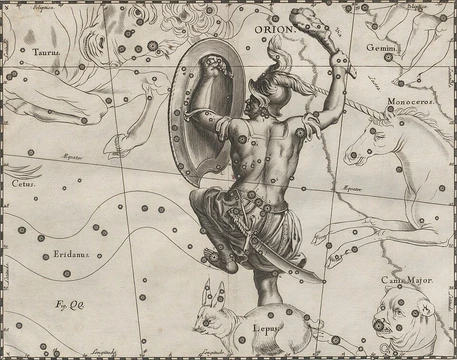
Orion is a popular starting point because its bright belt and hourglass shape are easy to spot from mid-northern latitudes in winter. Ursa Major, which contains the well-known Big Dipper asterism, is another great first target since it stays above the horizon year-round in the Northern Hemisphere.
What's the difference between a constellation and an asterism?
A constellation is an officially bounded region of sky, while an asterism is a recognizable star pattern that may sit inside one constellation or stretch across several. The Big Dipper, for instance, is an asterism nested within the larger constellation Ursa Major.
Which constellation holds the North Star?
Polaris, the current North Star, resides in Ursa Minor (the Little Bear). It appears nearly stationary in the sky because its position closely aligns with Earth's rotational axis, which is why it has served as a navigation anchor for centuries.
What are the zodiac constellations?
The zodiac constellations are the group of star fields that the Sun, Moon, and planets appear to drift through over the course of a year. They form a band along the ecliptic and have been central to both early astronomy and cultural astrology for thousands of years.
Can I see all 88 constellations from a single location on Earth?
No—your latitude determines which slice of the sky is visible, so no single spot reveals the full set. Northern observers, for example, never see southern groups like Crux or Centaurus, and the reverse is true for southern observers.
What's the largest constellation by area?
Hydra, the Water Serpent, spans roughly 1,303 square degrees, making it the biggest of the 88. It snakes low through the southern sky and is composed of relatively faint stars, so it's harder to pick out than its brighter, more compact neighbors.
Do constellations change shape over time?
The individual stars drift slowly due to their own motions, so the visible patterns will gradually reshape over tens of thousands of years. The official IAU boundaries, however, remain fixed, meaning the constellation as a defined region of sky persists even as its member stars migrate.